Showing posts with label Cookies. Show all posts

Wednesday, April 12, 2017

Carrot Cake Macaroons—with video! (AIP, Paleo, Vegan)

Carrot Cake Macaroons (AIP, Paleo, Vegan)

It had been ages, and ages since I made coconut macaroons… I had forgotten what a fun, bit-sized treat they are, and how easy it is to make them!

Carrot Cake Macaroons (AIP, Paleo, Vegan)

With Easter coming up this weekend, I wanted to create a macaroon that mimicked the flavor of a classic Easter favorite: carrot cake. Adding grated carrot, spices, and raisins to the macaroon base recipe worked great! As a bonus, including vegetables in dessert ups the nutrient profile just a bit and helps me feel better about the occasional indulgence. I love creating treats that mimic “the real deal,” but are more healthful and won’t derail my diet and lifestyle choices.


Also, I’ve created another recipe video to show just how easily these macaroons can be made :)

Carrot Cake Macaroons (AIP, Paleo, Vegan)

A note about my recipes: I ALWAYS recommend baking by weighted measurements to ensure the most successful baked goods. I've included volume measures, but they have been determined by math and are not tested. 

Carrot Cake Macaroons
yields 20 macaroons

120 grams (1 1/2 cups) unsweetened finely shredded coconut flakes
7 grams (1 tablespoon) coconut flour
1/2 teaspoon ground cinnamon
1/4 teaspoon ground mace (or sub nutmeg, if not AIP)
1/8 teaspoon ground cloves
1/8 teaspoon fine grain sea salt
50 grams (1/2 cup) finely grated carrot
28 grams (2 tablespoons) melted coconut oil
78 grams (1/4 cup) Grade B maple syrup
1 teaspoon vanilla extract
40 grams (1/2 cup) raisins

  1. Preheat the oven to 350 F. Line a baking pan (I used a half sheet) with parchment paper
  2. In a food processor, pulse together the coconut flakes, coconut flour, cinnamon, mace, cloves and sea salt to combine everything. 
  3. Add the grated carrot, and pulse just until the carrot is distributed throughout. 
  4. Pour the coconut oil, maple syrup, and vanilla extract over the coconut mixture. Pulse until combined. 
  5. Transfer to a separate bowl and stir in the raisins.
  6. Use a 1 tablespoon cookie scoop, packed with dough, to portion the macaroons onto the parchment lined pan. 
  7. Bake for 8 minutes in the preheated oven, rotate the pan, and bake for an additional 7 minutes. Remove from the oven & allow the macaroons to cool completely on the pan. 
  8. Store leftovers in an airtight container. The macaroons may lose their crispness over time, depending on the humidity. 

Notes:

  • You can substitute honey for the maple syrup, though they will not longer be vegan.  
  • I do NOT recommend reducing the sweetener or swapping it for a non-liquid one, or else the macaroons will not hold together. 
Carrot Cake Macaroons (AIP, Paleo, Vegan)

This post contains affiliate links, meaning Sweet Treats makes a small commission off items purchased 
after an Amazon link is clicked with no additional cost to you. Thanks for your support.

Friday, December 9, 2016

Spritz Cookies (AIP, Paleo, Gluten-free)

Spritz Cookies (AIP, Paleo, Gluten-free)

My Grandma Vein is a really fantastic baker. She makes wonderful treats for all holidays, but especially during the Christmas season. One of my favorite christmas cookies is her spritz cookies, a butter cookie dough pressed through a cookie press into different shapes. Some people flavor the cookie dough with vanilla and some with almond—Grandma’s spritz recipe uses vanilla. She would leaves some of the dough naturally colored and colors part of it red and green. She also would sprinkle the pressed cookie dough with various colored sanding sugars and sprinkles before baking.

Spritz Cookies (AIP, Paleo, Gluten-free)

My AIP variation might look and taste a little different, but the first test batch cookie I popped into my mouth was like tasting a memory of Christmases past. Despite using palm shortening in lieu of butter, they still have a "buttery" flavor; they also have some lovely notes of maple and just a hint of coconut.

Spritz Cookies (AIP, Paleo, Gluten-free)

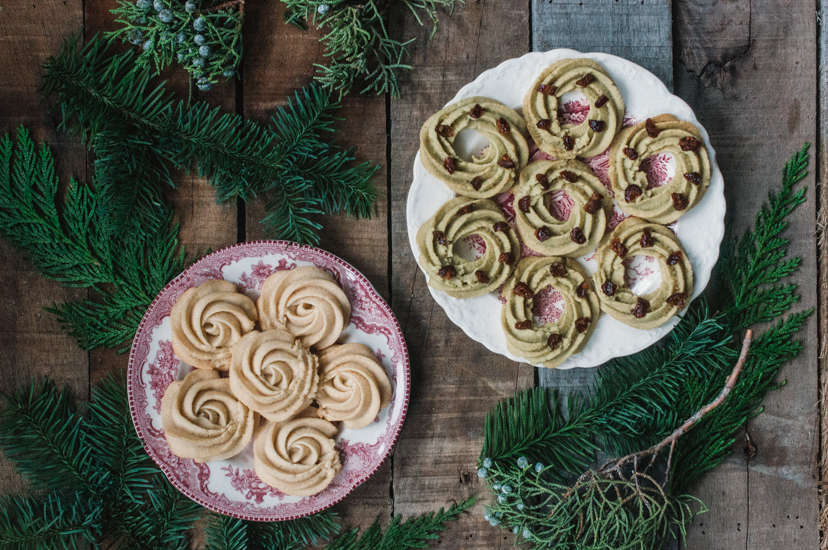
Instead of pressing the dough through a cookie press, I chose to pipe it with a pastry bag fitted with a large start tip into rosettes and wreath shapes—I couldn’t justify buying (or storing) a new cookie press & I’m not sure if my vintage press has any gluten remnants.

Spritz Cookies (AIP, Paleo, Gluten-free)

I didn't have many ideas for natural ways to color the dough, but I did add matcha green tea powder to the dry ingredients of one batch & it worked really well, though it does make the cookies taste like green tea. I suspect a few drops of beet juice might work well to make a more red/pink dough; however, I have a sensitivity to beets so I have not tried it out. To make the wreaths look more like actual wreaths (and less like piped circles), I added some chopped dried cranberries (apple-juice-sweetened) and a tiny sprinkle of turbinado/raw sugar.

Spritz Cookies (AIP, Paleo, Gluten-free)

Because these cookies are so delicious, I’ve purposely made the batch really small—depending on how big they’re piped, you should be able to get around 16 cookies. If you’re one with lots of willpower, even around lots of delicious AIP cookies, make a double batch :)

Spritz Cookies (AIP, Paleo, Gluten-free)

Happy Baking! PS if you’d like to make the AIP gingersnaps pictured on the cookie platter, make sure you grab a copy of my e-book “Holiday Sweet Treats.

Spritz Cookies (AIP, Paleo, Gluten Free) 
yields around 16 cookies

64 grams(1/4 cup) palm shortening
39 grams (2 tablespoons) Grade A dark maple syrup
1 teaspoon vanilla extract
23 grams (3 tablespoons +1 teaspoon) coconut flour 
25 grams (3 tablespoons +1 teaspoon) tapioca starch
27 grams (3 tablespoons +1 teaspoon) arrowroot
3/4 teaspoon gelatin
1/8 teaspoon paleo baking powder (recipe follows) 
pinch of sea salt
  1. Preheat the oven to 350 F. Line a baking sheet with parchment paper. Fit a pastry bag with a large star tip (I used a Wilton bag fitted with an 824 Ateco tip). 
  2. In a medium mixing bowl, cream together the palm shortening with the maple syrup and the vanilla extract with a silicone spatula until well combined. If the palm shortening is too solid to properly mix—mine typically is during the winter—allow the ingredients to warm up slightly on the preheating stove. A hand mixer may also be used. 
  3. In a separate bowl, whisk together the coconut flour, tapioca, arrowroot, gelatin, paleo baking powder, and sea salt. 
  4. Add the dry ingredients to the shortening/maple/vanilla and mix until well combined. 
  5. Transfer the dough to the prepared pastry bag. Pipe the dough into rosettes, starting from the center & swirling outward. Draw circles as guides on the bottom of the parchment paper, if needed. Leave a little space between the cookies to allow them to puff a little during the baking process. 
  6. Bake the cookies in the preheated oven for 6 minutes, then rotate the pan and bake for an additional 2 to 3 minutes, or until the cookies are just starting to turn golden on the edges. 
  7. Allow the cookies to cool completely on the pan before serving. 
  8. Store cookies in a single layer in an airtight container at room temperature or in the freezer. Leftover cookies may soften, so re-crisp in a warm oven, if needed, before serving. 
Matcha Wreath Variation
Same ingredients as above with the addition of:
A heaping 1/4 teaspoon of matcha green tea powder
Apple juice sweetened dried cranberries, chopped
Turbinado/raw sugar
  • Make the same recipe as above, adding a heaping 1/4 teaspoon of matcha green tea powder to the dry ingredients. Mix the green tea variation dough with a hand mixer too, just to ensure there are no tiny lumps of matcha. 
  • Pipe the dough into rings & press chopped dried cranberries into the rings. Sprinkle a little turbinado sugar over the wreaths. 
  • Bake as instructed above, though the wreaths may bake more quickly depending on how they thick they are piped, so watch them carefully. 
Paleo Baking Powder
81 grams (1/2 cup) cream of tartar 
55 grams (1/4 cup) baking soda
30 grams (1/4 cup) arrowroot or tapioca 
  1. Sift together the cream of tartar, baking soda, and arrowroot/tapioca.
  2. Store in an airtight jar. Use wherever baking powder is used. 

This post contains affiliate links, meaning Sweet Treats makes a small commission off items purchased 
after an Amazon link is clicked with no additional cost to you. Thanks for your support.
SaveSaveSaveSave

Saturday, September 27, 2014

Blog Birthday & Coconut Macaroons (AIP, Paleo)


I’m feeling in a celebratory mood (and a tish nostalgic). Friday was “Sweet Treats” 5th birthday! So much has happened in the five years I’ve been baking, photographing & writing in this space…. 

When I started “Sweet Treats,” I had recently moved across the country, all by myself to Charleston, SC, and was enrolled in my first semester of pastry school at the Culinary Institute of Charleston. I had already been reading food blogs for several years and I figured that starting my own food blog was a great way to merge my background in graphic design & photography with my other love: baking and pastry. Plus, I kept reading about the “Daring Bakers” challenges on different blogs, and I wanted to participate. My very first Sweet Treats post chronicled my first DB challenge: vols-au-vents. I continued with many DB challenges until ultimately my work schedule made it impossible to complete the projects. Also over the first couple years of posting, I chronicled projects made both as a pastry student and instructor.

(some highlights from the past 5 years of blogging)

I’ve had fun re-reading the “Sweet Treats” archives & looking through old pictures. If you’d asked me in September of 2009 (when I started Sweet Treats the blog) where I thought I’d be in 5 years (2014), I never would have guessed that I’d be where I am today.  Along this journey, life has taken some very different paths than I ever expected....
  • Teaching at CIC: Before attending culinary school, I spent some time teaching in a demonstration kitchen . I loved teaching and was thrilled when I was unexpectedly asked to become a pastry chef instructor at CIC after my first year as a student. I taught a variety of different courses & feel very thankful for all I learned in developing much of my own curriculum and from my teaching experiences.  One of the hardest parts of leaving Charleston was leaving my job at CIC--I still miss the classroom!! 
  • Meeting Helene Dujardin: One of the very first food blogs I ever read was Helen’s Tartelette. At the time, I had no idea that she lived in Charleston (or that I’d be living in that city one day), but through the wonders of social media & email, we eventually connected and became friends in-real-life!!  She is such a gem (and the best wedding photographer we could have asked for). 
  • Meeting Tami Hardeman Boutté: Through working as the kitchen manager for several of Helene’s food photography workshops, I met Tami, who also has become a great friend. If ever you find yourself stranded in the ATL area due to an unexpected snowstorm, I highly recommend getting stranded at Tami’s house :) I’ve since also been fortunate to work as a food styling assistant for her on a commercial job. (and, hopefully for another shoot next month!) 
  • Moving to Texas: When I first moved to Charleston, I didn’t know how long I’d be there.... a year? Two years? More? But I certainly didn’t expect to end up in the middle of nowhere Texas, thanks to my husband’s job. The things one does for love :) Everyday of living here is a bit of an adventure, but I wouldn’t have it any other way. 
  • Instagram: Let’s be honest, Instagram has become a staple in my life. I may have a bit of an addiction, but the way I see it, Instagram helps me get to know people I never would have found before & helps me keep in touch with friends and family who live far away. And I’m able to share more behind-the-scenes things about my everyday life. Spoiler alert: not every recipe is successful & my entire life most definitely isn’t Pinterest-worthy. 
  • Adventures with autoimmune conditions: Shortly after moving to Texas, my health problems began to compound, and I began searching for answers. After many visits to various doctors and a plethora of tests, multiple autoimmune conditions were diagnosed. Subsequently, I’ve made a number of dietary and lifestyle changes that I never anticipated making. Going “gluten-free” was not a choice I made based on a fad--it was a necessity! (as was a year of eating only foods with low acid properties...) I’ve tried conventional medications, some with success, though most included unpleasant side-effects. I’ve also had to come to terms with the fact that there is no quick fix for autoimmunity, or even a 100% cure. In all actuality, I will be dealing with these conditions (in some shape or form) for the rest of my life; there are steps I can take to manage my symptoms, but I still will need to be very self-aware. 
  • Paleo & the Autoimmune Protocol (AIP): I never expected to find myself following the Paleo lifestyle. I thought Paleo was silly, and expensive. How could I, a pastry chef, ever expect to give up ALL grains, as well as many other ingredients I considered to be “staples” ?!? As it turns out, the clinical nutritionist/functional medicine doctor I began seeing in April 2014 uncovered a ridiculous amount of food sensitivities, which, coupled with my other autoimmune issues, basically put me not just on a paleo diet, but the even stricter autoimmune protocol of paleo (aka AIP). The results from following AIP, along with supplements & treatments from my doctor, showed dramatic improvement of my symptoms almost immediately. I’m going to be honest, though: AIP is a lot of work & takes a decent amount of planning. It isn’t always fun or easy (and it isn’t always a miracle cure), I think it is the best option for me. While I hope to not have to follow strict AIP forever (I’m already on the reintroduction stage), I do think staying on a paleo-esque diet will be important for the foreseeable future (and that gluten and I will never be friends again).


The past 5 years have certainly had their roller coaster moments of high highs and low lows, but I’m choosing to celebrate them with an AIP-friendly coconut macaroon recipe. These macaroons are free from dairy, eggs, gluten/grains, and refined sugar, but they’re not free from delicious taste. In fact, I do have to hold myself back from eating too many.....

As I’ve jumped head first into the autoimmune protocol and watched my life change dramatically in the past months, I’ve also been thinking a lot about this space. How on earth does a pastry chef with a dessert blog adapt her subject matter to fit within paleo/aip and not completely alienate her readers? I keep returning to two principles 1) staying true to myself and 2) helping others. Here are some of my thoughts as I look to the future:

  • I have to keep my health in check. One of the major healing components of AIP is low-sugar consumption, even if that sugar is from natural or unrefined sources. It simply is detrimental for me to make sweets as often as I have in the past. They should be an occasional treat, not a regular thing. 
  • While I might not be eating sweets as often as I did in the past, I am eating some really fantastic foods that not only taste great but make me feel better too. I plan on posting more of these every-day “staples” and savory foods, although I won’t lose the sweets entirely. I often post pictures of what I’m eating on Instagram, partially to remember what I’ve eaten and partially to show people that although   AIP can be a bit daunting at first (and honestly sort of a lonely journey) & one of my goals moving forward is to take my experiences & recipes to help inspire people to live a more healthful lifestyle (though note that everyone is different, so my dietary choices might not be the best choices for you). 


Whew! I feel like I’ve written a novel :) I do want to thank you, my readers, for sticking with me on this journey. It hasn’t been what I would have predicted, but I can’t wait to see where it leads! I’m grateful for your company along these adventures. Please let me know if there are any topics or recipes you’d like to see me cover.  And even if you’re not following AIP, I still encourage you to make these fantastic macaroons. They couldn’t be easier or more delicious.


Coconut Macaroons (egg-free, paleo, AIP)
Yields approximately 18 cookies

pinch Sea Salt
26 g (2 Tbl) Organic Coconut Oil, room temperature
85 g (1/4 c) Organic Honey (or sub maple syrup to make vegan) 
1 Tbl Vanilla Extract (optional for AIP) 
  • Preheat the oven to 350 F. Line a baking sheet with parchment paper & set aside. Note: I used my toaster oven & a quarter sheet baking pan.
  • Pulse the shredded coconut, coconut flour and sea salt in a food processor until combined. 
  • Add the oil, honey & vanilla extract & pulse until well mixed. 
  • Use a 1 Tbl cookie scoop to portion mounds of dough onto the prepared baking pan. Pack the dough into the scoop to ensure all macaroons are the same size. 
  • Bake for 10 minutes (rotating the pan after 5 minutes), or until lightly golden. Remove from the oven and allow to cool on the pan at least 10 minutes. Store any leftovers in an airtight container. Macaroons may lose their crispness over time, depending on the humidity. 

This post contains affiliate links. Thanks for supporting Sweet Treats. 

Tuesday, April 15, 2014

Easter Egg "Cascarónes" Cookies


Last year, my first in a Texas/Mexico border community, I was ushered into a world of a new-to-me Easter tradition: cascarónes. With a quick crack on the top of my head, and a shower of colorful confetti, I officially experienced “cascarónes” aka “confetti eggs.”  Just remember, when cracking cascarónes on someone’s head, use an open palm & crack the egg on the back of the head nowhere near the eyes!


Cascarónes are made by breaking open one end of an egg, disposing of the egg white/yolk, cleaning, drying & decorating the empty shell, then filling it (usually with confetti) & gluing tissue paper over the hole. You can make them yourself (I actually really love this post on Oh Happy Day--such great pictures!)  But, I must confess, around this area, there are SO MANY pre-made very, very inexpensive cascarónes available that I cheated & used the store bought.


While brainstorming Easter cookies (and Easter Traditions), I suddenly remembered that once-upon-a-time, I pinned a recipe for piñata cookies, which featured three layers of baked sugar cookies, with the middle layer hollowed out to make room for candy. When the finished piñata cookie was broken, out poured candy (not too different than a real paper mâché piñata. (side note, I am *really* getting to use the special characters in this post, haha).


I thought about how similar the piñata cookies are with cascarónes, only you don’t traditionally break a cookie over someone’s head--in my world that would be the shameful waste of a good cookie! But I decided to merge the concepts of piñata cookies with the idea of confetti eggs.  And voila, Cascarónes Cookies.


As with any sugar cookie, these do take some time, though much of it is inactive as you wait for things to dry/rest/cool etc. There are tons of absolutely gorgeous easter egg decorated cookies, but I was a bit short on time (I was simultaneously working on this project ). I tried to keep things simple: a white outline flooded with pastel colors & white dots.


One of my biggest challenges (aside from finding time to actually finish these cookies) was finding the right candy to go inside. Because I wanted the cookies to mimic the confetti eggs & have lots of small-ish candy spill out when eaten, I was searching for the smallest size Easter candy possible.  Both my husband and I scoured several stores, with little luck. I thought I would have to settle for mini m&ms (whose primary colors sort of clashed with my already-decorated pastel cookie tops), but then I discovered a gem in a craft store in San Antonio: chocolate covered sunflower seeds! And they were pastel for Easter!  Win! (Side note: I am also no longer allowed to buy chocolate covered sunflower seeds because I cannot seem to stop eating them).  


Really, this concept could translate to most any cookie design, but I do have a few recommendations.  First, make sure your cookie dough is one that holds its shape very well when baked--my recipe (listed below) doesn’t have baking soda or baking powder in it, so it doesn’t spread or puff.  The cookie dough should be slightly thicker (especially for the middle layer) than you may normally roll it, but that will ensure a sturdy cookie, with plenty of space for candy.  Feel free to substitute whatever small candy fits inside.


Secondly, royal icing does dry really hard and the first couple of bites into the cookie can be a little challenging. If making these for kids, I’d recommend having the parents help to “open” the cookie for the child.


Sugar Cookie Dough 
(sorry, I don’t have volume measurements for this recipe!) 

200 g Unsalted Butter, at room temperature
200 g Granulated Sugar
1 egg, room temperature
1 tsp Vanilla Bean Paste
Generous Pinch of Sea Salt
380 g AP Flour (increase to 400 g, if live in a humid area)--

  1.  Cream together the butter and sugar in the bowl of a mixer fitted with the paddle attachment.  Mix on low speed until completely combined. Scrape down the sides of the bowl. 
  2. Add the egg and vanilla and mix again on low speed until just combined. Be careful not to incorporated too much air into the dough.  
  3. Add the flour and salt. Mix on low speed until the flour is just incorporated and the dough forms a ball. 
  4. Wrap the dough in plastic wrap & flatten into a disc.  Refrigerate a minimum of 30 minutes (thought overnight is best).  Rolling/baking/decorating instructions will continue below.  
Gluten Free Adaptation: May also substitute Jeanne's GF AP Flour mix to make a gluten-free version. 


Royal Icing 
half recipe courtesy of Sugarbelle  

Note: I’ve recently switched to this new royal icing! I find it’s easier to make & works better. 

1lb (half of a bag) of confectioners’ sugar
27 g / 2.5 Tbl Meringue Powder
1 to 1.5 tsp oil-free extract or emulsion (I used imitation almond this time, with a tiny bit of vanilla)
3 oz Warm Water

  1. In the bowl of a stand mixer fitted with the paddle attachment, stir together the sugar and meringue powder. 
  2. Meanwhile, add the flavoring to the warm water. 
  3. While the mixer is still running on it’s lowest setting, slowly add the water/flavoring. 
  4. Increase the mixer speed to medium and mix for 2 to 4 minutes, or until the icing is fluffy and thick. Ideally mix only until the icing will hold a soft peak.  
  5. Store icing in an airtight container with a wet paper towel pressed into the surface.  
  6. Color the icing as needed. 
Cookie Baking
  • Preheat the oven to 350 F. Line two baking sheets with parchment paper
  • Roll out the cookie dough evenly between two layers of parchment. The dough should be rather thick--mine were around 1/4 inch.  

  • Use a large oval cookie cutter (oval cutter)  to cut out 10 ovals. Place the ovals onto a baking sheet. 

  • Use a slightly smaller oval to press a slight “guide line” indentation into the tops (5 total), if desired, to later help with piping the icing. 
  • Bake the large ovals for 10 minutes, then rotate the pan and bake for approximately 10 more minutes. Due to their thick nature, these cookies may take a bit longer than others.... The cookies should be done, but not yet developed any color. Once baked, allow the cookies to cool completely. 
  • Meanwhile, re-roll, if necessary, and cut out 5 more large ovals.  Place those onto the second prepared baking sheet & refrigerate until firm (approximately 10 to 20 minutes.  Use a smaller oval to cut out the centers of each cookie (to leave room for candy later), and use a small offset spatula, if necessary, to remove the middle.  The middle cookies and the small ovals can be baked on the same baking pan.  Refrigerate for 10 minutes. 
  • Bake the second sheet for 10 minutes, then rotate the pan and bake for approximately 8 more minutes. 
  • Re-roll any scrap pieces & cut them into any shapes you like. 
Decorating & Assembly
  • Match up two large cookies with one middle cookie. 
  • Using a #3 round tip & thick white icing, outline the top cookies.  Allow to dry at least 30 minutes. Do the same with any small ovals too (or other shapes made from re-rolled scrap pieces). Save the remaining white icing for the cookie assembly 
  • Flood the inside of the outlined cookie with a pastel colored icing. Use a toothpick or scribe tool to coax the icing into all areas of the cookie. Swirl to release any air bubbles. Quickly pipe white polka dots into the wet icing.  Allow to dry several hours (though overnight is best). 
  • When ready to assemble the cookies, gather the reserved white icing, the prepared (and dried) cookies, and whatever candy you’ve chosen for the filling (I used chocolate covered sunflower seeds. 
  • Pipe a ring of icing near the edge of the bottom cookie, taking care not to pipe too close to the edge, or the icing may drip off the sides. 
  • Gently top with the middle cookie. Allow to dry at least 30 minutes. 
  • Fill the center cavity with the candy 
  • Pipe royal icing on the cookie ring.  Top with the decorated cookie & press gently to adhere.  Allow to dry at least 1 hr.  
  • Decorated cookies will keep for several weeks, if wrapped well with plastic wrap and/or stored in an airtight container.  

This post contains affiliate links. 

Monday, March 10, 2014

Samoa Squares (Gluten Free)


I dream of many things these days... (note: this is not a comprehensive list) The end of this crazy winter (where one day we have the AC on and the next day have to switch to heat). Fresh flowers. Vacations. One day learning to like exercise. A kitchen with a window in it (and marble counter tops too, while we’re dreaming). Paying off student loans. Living nearer a Trader Joes and Whole Foods (though I’m sure it’s better for my pocketbook that I don’t). And Gluten Free Girl Scout Cookies.   Luckily, I can make my own gluten free version of my Girl Scout cookie of preference: Samoas (or Caramel Delites, depending on where you are in the US).


If you think about it, Samoas have quite a few components: the shortbread crust (chocolate crust), the chewy caramel/coconut layer, the chocolate drizzle.... So, I made gluten free Samoa Squares with just a few adaptations to make them a bit easier.  Gluten free shortbread is more fragile than regular shortbread because in addition to not having gluten (i.e. proteins that help provide structure in regular baked goods), shortbread traditionally lacks another structural item: eggs. Making a bar-type cookie that is cut into squares *after* it is assembled is much easier than rolling out the the slightly crumbly dough and attempting to cut out individual cookies. Plus, then the caramel/coconut mixture can be spread on top all at once, and not individually portioned & spread onto each separate cookie base.  Then, instead of dipping the bottom in chocolate, I added a chocolate layer in between the baked shortbread and the coconut caramel. Just a few short-cuts that make the assembly easier, but the squares still taste (and look) amazing! Next time, I may even make a double batch (though then I’d be tempted to eat way, way too many of them....).  


My next dream is to perhaps to take a few of the leftover Samoa Squares make a milkshake or ice cream sundae with a couple leftover Samoa Squares. And perhaps tackle a gluten free version of the Thin Mint (my second favorite).  


Gluten Free Samoa Squares 
Yields approximately 16 squares

Shortbread Base (adapted from Annie’s Eats) 
4.25 oz (1c) GF AP Flour (or substitute AP flour, if not Gluten Free)
1 tsp Baking Powder
1/4 tsp Salt
3 oz Coconut Oil, solid
1.75 oz (1/4 c) Granulated Sugar
3/4 tsp Vanilla Bean Paste
  1. In a small bowl, whisk together the flour, baking powder & salt. Set aside
  2. In a slightly larger bowl, use a spatula to cream together the solidified coconut oil and the granulated sugar. Add in the vanilla bean paste. 
  3. Pour all the dry ingredients into the creamed mixture & continue mixing, using a spatula, until a soft dough forms.  
  4. Line an 8x8 pan with parchment paper (I find it’s easiest to crumple the paper first, then try to line the pan with it)--don’t worry if it’s not perfect. 
  5. Press the evenly dough into the prepared pan. (I used my fingers). Chill the pan in the refrigerator for 10 minutes.  
  6. Preheat the oven to 350 F. Bake the chilled dough for 15 minutes, or until the dough is baked through and very lightly golden brown. 
  7. Set aside to cool.  Keep the oven on to toast the coconut. 
Chocolate Layer
2 oz semi-sweet Chocolate Chips 
1 tsp (6 g) Coconut Oil 
  1. In a small bowl, combine the chocolate chips and coconut oil. Microwave for 30 seconds, stir. Microwave for additional 10 second increments, stirring after each session, until the chips are melted.  
  2. Evenly spread over the baked, cooled shortbread base. Allow to set. 

Coconut Caramel Topping (adapted from Cooking Classy)
90 g (3/4 c) sweetened coconut flakes, divided
6.9 oz (approximately 24) Kraft Caramels, unwrapped (note, weight is taken after unwrapping)
2 1/2 Tbl Milk (approximately 33g) 
  1. Spread the coconut flakes onto a small pan. Toast in a 350 F oven until brown (but not burned)--Mine took about 15 minutes. Stir approximately every 5 minutes to ensure even browning. Set aside to cool. 
  2. In a small sauce pan, heat the unwrapped caramels and milk over medium heat. Stir constantly until the caramels are just melted. Set aside to cool slightly. 
  3. Meanwhile, pulse the toasted coconut in a food processor until finely processed. Remove 60 g (approximately 1/2 c) and set aside both the 60g and the remaining. 
  4. Pour the 60g of coconut into the caramel and mix to combine.  Carefully spread in an even layer over the chocolate covered shortbread. Top with the remaining coconut & press into the caramel.  Allow to set completely.
  5. Use a sharp knife to cut the coconut/caramel/chocolate topped shortbread into 16 equal squares. Spread the cut squares out slightly on the parchment paper in preparation for the chocolate drizzle. 
Chocolate Drizzle (adapted from Cooking Classy)
Note: this will make more than needed, but it’s rather difficult to make the batch much smaller than it already is. 

35g (2 1/2 Tbl) Coconut Oil, solid
10 g (2 Tbl) Cocoa Powder
1 oz (1/4 c) Confectioners sugar
  1. In a small bowl, mix together the coconut oil and cocoa powder.  Heat for 10 seconds, or just until melted. Stir.
  2. Add the confectioners’s sugar and mix until combined.  Heat for an additional 10 seconds, or until just slightly warm & of a pipe-able consistency.  Additional coconut oil may be added if the mixture is too thick.  
  3. Place the chocolate into a cornet paper piping bag or a small ziplock.  Barely cut off the tip (or corner) and carefully stripe cross the squares.  Allow the chocolate to drizzle across the *entire* square so that you don’t end up with the “toaster strudel” effect ;) 
  4. Allow the chocolate to set at room temperature. Store any leftovers at room temperature. 
Please note: When I made these squares, I used the weighted measurements which will be more accurate. I’ve included some volumetric amounts too, though I have not personally tested them.