Showing posts with label Lemon. Show all posts

Friday, May 6, 2016

Arugula Pesto (Dairy-free, Nut-free, AIP, Paleo, Whole30)

Arugula Pesto (Dairy-free, Nut-free, AIP, Paleo, Whole30, 21DSD, Vegan)

Have I mentioned before that I don’t care for basil? There are only a handful of foods I truly do not like (olives are at the top of that list), but basil definitely makes the list. I’ve been ok with conventional (aka basil-based) pestos in the past, but only if they had copious amounts of garlic, cheese, nuts to mostly cover up the basil flavor. Since I’m not currently consuming dairy or nuts, basil pesto does not appeal to me. However, arugula pesto is a whole different story! 

Arugula Pesto (Dairy-free, Nut-free, AIP, Paleo, Whole30, 21DSD, Vegan)

My idea for arugula pesto came out of two circumstances. First, I had a container of arugula near the end of it’s life in my refrigerator. Secondly, I was looking for a way to “spice up” some otherwise slightly bland fish filets…. 

Arugula Pesto (Dairy-free, Nut-free, AIP, Paleo, Whole30, 21DSD, Vegan)

I experimented by throwing arugula, cilantro (parsley would also work), garlic, lemon & oil into one of my blender cups & blended everything together. The pesto turned our borderline-bland fish to something fantastic. Not to mention that the nutritional value was increased by the extra greens & herbs.

Arugula Pesto (Dairy-free, Nut-free, AIP, Paleo, Whole30, 21DSD, Vegan)

After that first meal, I also discovered the leftover pesto was delicious on all sorts of things….. Melted over a ground meat skillet meal.  Stirred into a bowl of steaming hot soup. Tossed with roasted potatoes (or other roasted veggies). Served alongside chicken as a dipping sauce.

Arugula Pesto (Dairy-free, Nut-free, AIP, Paleo, Whole30, 21DSD, Vegan)

Now I’m buying arugula specifically to make this pesto, instead of relying on leftovers. I foresee keeping a jar of this magical, nutritious sauce in our refrigerator at all times & continuing to add a dollop to all sorts of things… I’m thinking perhaps zucchini noodles/zoodles & shrimp next!

Arugula Pesto 
yields one small jar 

Note: I make single jars of this sauce by blitzing everything in my Ninja blender's smoothie cup. If you plan to make it in a larger blender vessel or in a large food processor, I’d recommend doubling the ingredient amounts. 

1 1/2 packed cups (approximately 54 g) Arugula
1/3 packed cup (approximately 10 g) Cilantro (leaves + stems is fine) 
1 peeled clove of garlic 
1/3 c (74 g) Olive Oil 
1 heaping tsp Lemon Zest
1 Tbl + 1 tsp Lemon Juice (fresh is best) 
1/4 tsp Kosher Salt 
  1. Add all the ingredients to small blender vessel or food processor. 
  2. Process until all the arugula & cilantro are well chopped & blended. 
  3. Pour into a small glass jar (I used a Weck jar); the color will darken/turn a bit more olive-toned over time. Store in the refrigerator. Serve cold or bring to room temperature before serving. 

This post contains affiliate links, meaning Sweet Treats makes a small commission off items purchased 
after an Amazon link is clicked with no additional cost to you. Thanks for your support.  

Friday, April 8, 2016

Egg-free Tuna Salad (AIP, Paleo, Whole30)

Egg-free Tuna Salad (AIP, Paleo, Whole30)

From kindergarten through 8th grade, my two younger sisters and I attended a very small private school that did not have a traditional school lunch program, meaning that my mom packed lunches for us most days. One of my very favorites, probably more towards the middle school side of education, was tuna salad with corn chips & a tiny can of V8. The tuna salad—based on my Grandma Jones’s recipe—was made with canned tuna, kraft mayo, diced celery, celery seed & onion powder. I can still taste her version now, if I really think about it.

Egg-free Tuna Salad (AIP, Paleo, Whole30)

Egg-free Tuna Salad (AIP, Paleo, Whole30)

Tuna salad has changed a lot for me these days. It also has become something I eat not just because I like it but because i know it’s really good for me, especially with ingredients like sauerkraut & fresh veggies that my version incorporates. What took me the longest in my AIP tuna salad appreciation has been to get over the lack of mayo. I’ve tried a number of AIP “mayo” recipes, but honestly, in tuna salad I find a mashed avocado works better as a regular mayo replacer.

Egg-free Tuna Salad (AIP, Paleo, Whole30)

Egg-free Tuna Salad (AIP, Paleo, Whole30)

I’ve also grown to appreciate tuna salad because I typically have all the ingredients for it on hand, meaning that I can easily make it for a meal if other plans have fallen through (or if I simply didn’t start lunch prep early enough). In a pinch, I’ll eat the tuna salad by itself, but most of the time, I prefer it served over salad greens, or with plantain chips (a throwback to my days of eating tuna salad on corn chips), or on cucumber slices.

Egg-free Tuna Salad (AIP, Paleo, Whole30)

Egg-free Tuna Salad (AIP, Paleo, Whole 30) 
yields 1 large serving or two small servings 

1/2 of a large (90 g) Avocado, mashed
1 tsp Lemon Juice (fresh is best, but bottled works in a pinch)
1-5 oz can Canned Wild Caught Albacore Tuna  (do not drain or rinse)
2 Tbl (30 g) Sauerkraut (homemade is best)
1/3 c (42 g, approx 1 stalk) Celery, diced
1/4 c (42 g) Cucumber, diced
3 Tbl (9 g) Scallions, sliced
1/4 tsp Sea Salt

Plantain Chips, Cucumber slices, and/or salad greens for serving

  1. In a medium mixing bowl, mash the avocado and lemon juice with a fork. 
  2. Add the tuna (with the juices, do not drain or rinse for optimal omega 3 level), breaking it up with a fork & combining it with the avocado/lemon. 
  3. Mix in the sauerkraut, diced celery, diced cucumber, sliced scallion & sea salt. 
  4. Serve with plantain chips and cucumber slices, or over salad greens. 
This post contains affiliate links. Thanks for supporting Sweet Treats.

Monday, May 5, 2014

Lemon Raspberry Pavlova (GF)


Forgive my unexpected time lapse between posts.  By now, I ought to know that when I’m taking a trip back to North Dakota (which is where I've been the past two weeks), I really won’t have time to finish a post, even if I have the best intentions of doing so, haha.  I’m also sorry for not sharing this lemon raspberry pavlova with you sooner! It’s a keeper. 


Every time I make a pavlova for dessert, I wonder why I don’t make it more often. It’s very easy to make & naturally gluten free, not to mention super tasty. Luckily, I’ve gotten a couple friends hooked on it, and they remind me to make it :) When one of those aforementioned friends celebrated her birthday a few weeks ago, I knew it was the perfect time to test out a pavlova variation that has been rolling around my head for quite a while.....


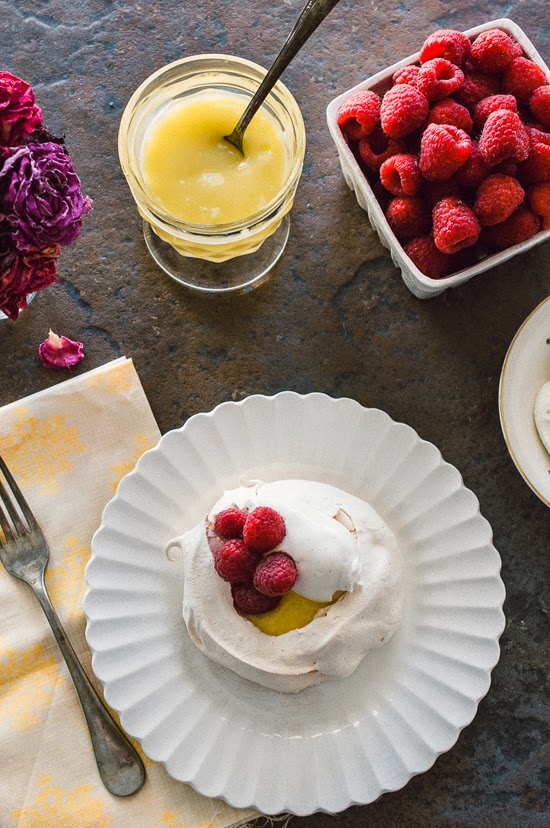
 Most often, when I’m making pavlova, I make a version of the Berry Pavlova I posted last July; however, this time, I switched things up. I don’t know if there’s a way to make a pavlova more elegant than it already is, but somehow crafting it into individual portions seems to do the trick. Plus, they’re easier to serve at a dinner party (which is where I served these). And using tart lemon curd as the filling pared wonderfully with the sweet meringue shell. Top little whipped cream and a few raspberries & you’re set with a spectacular dessert.


Pavlova Shells
Yields 4 servings 

2 ea Whites
3.5 oz / 1/2 c Granulated Sugar
Vanilla Bean Paste/Vanilla Extract (optional, I forgot to add it to mine & they still tasted great!) 
1 tsp Cornstarch

  1. Preheat oven to 250 F. 
  2. Line a baking sheet with parchment paper & spray with cooking spray .  
  3. In the very clean bowl of a stand mixer fitted with the whisk attachment, add the egg whites.  Mix on medium-low speed until they become foamy.  Gradually add the sugar, a couple tablespoons at a time. 
  4. Once all the sugar is added, increase the mixer speed to high & whip until the mixture holds stiff peaks and becomes very thick & glossy.  
  5. Scrape down the sides of the bowl & add a splash of the vanilla bean paste/extract. Mix on high speed one additional minute.  
  6. Remove the bowl from the mixer & sift the cornstarch over the meringue.  Use a silicone spatula to gently fold in the cornstarch, taking care not to deflate the meringue.  
  7. Use a large portion scoop to portion the meringue into 4 small mounds on the prepared parchment. Use a small offset spatula to hollow out the center slightly to make room for the filling & fruit that will be added after baking.  
  8. Place the pan into the oven & immediately drop the oven temperature to 225 F. 
  9. Bake the pavlovas for 30 minutes, rotate the pan & bake for 15 to 30 additional minutes.  When done, the outside will be dry & firm to the touch, but the interior will be soft & marshmallow-y Ideally, the pavlovas should remain very pale cream in color. If they begin to brown, reduce the oven temperature, or even turn the oven off & allow the residual heat to finish the baking process. 
  10. Cool completely before assembly. If not planning to assemble & serve the pavlovas immediately, tightly wrapped the completely cooled meringue shell & store at room temperature so that it retains it’s crispy shell. 

Lemon Curd
sorry, I do not have a volume measurement for this recipe. If you run out of time to make your own curd, you could substitute store bought :)

80 g Egg Yolks
126 g Granulated Sugar
100 g Lemon Juice
25 g Heavy Cream
65 g Butter
  1. In a small stainless steel saucepan, whisk together yolks, sugar, juice, cream, and butter and cook over moderately low heat, whisking constantly, 5 to 7 minutes, or until mixture just reaches a boil (do not let boil). 
  2. Strain curd through a fine sieve into a bowl. 
  3. Cool curd with its surface covered with plastic wrap (pressed into the curd, so that it doesn’t develop a skin), and chill. Alternately, chill over an ice bath (with plastic pressed into the curd). 
  4. Curd may be refrigerated for up to 2 days. 
Assembly
Assemble just before serving

Cooled Pavlova Shells
Chilled Lemon Curd
Whipped Cream
Fresh Raspberries
Mint (optional garnish--my grocery store was completely out, so I couldn’t use any...) 
  1. Gently press the center of the pavlova shell to indent it a little further. 
  2. Spoon a little lemon curd into the indentation.
  3. Top with a quenelle (or dollop) of whipped cream & sprinkle with a few raspberries. Optional: garnish with a few sprigs of fresh mint. 
  4. Serve immediately! 

Tuesday, March 4, 2014

Blueberry Pancakes with Lemon (GF)


Is it a coincidence that I awoke thinking of pancakes on Mardi Gras? I think not......  Well actually, I was thinking more of muffins (these muffins to be exact), but pancakes provide a little more instant gratification (and I don’t have to wash the muffin pan).

Last week I discovered a great new pancake recipe when husband requested pancakes one morning for breakfast, but today was my first attempt at making them gluten free.  To further mix things up, in addition to substituting my favorite GF flour, I also added some lemon zest & frozen wild blueberries.   Somehow the flavors taste like spring (lemon) and summer (blueberry) and give me hope that this crazy winter won’t last forever.

We don’t do a lot of “fancy” breakfasts around here.  Greek yogurt (for him) and gluten free granola or cereal (for me) with coffee seem to be the norm these days. But every once and a while, one needs a special breakfast during the week. I foresee these pancakes also making it into our “brinner” (breakfast for dinner) rotation that we do from time to time.  Go ahead, indulge a little :) 

p.s. Don’t be alarmed at how liquid the batter is--they’ll turn in to one of the best textured pancakes I've ever made at home. But I do think the smaller pancakes turn out better than the larger ones!  

Blueberry Pancakes with Lemon (GF)
adapted from Martha Stewart
yields 8 medium pancakes

2 Tbl Granulated Sugar
Zest of 1/2 a small lemon (add more zest if you prefer a more noted lemon flavor)
2 tsp Baking Powder
1/4 tsp Salt
4.4 oz Gluten Free Flour (I used Jeanne's GF AP Flour Mix, or substitute regular AP flour if not GF)

1 large egg
2 Tbl Vegetable Oil (or could substitute butter that has been melted and cooled)
1 c Milk

Blueberries (I used Frozen Wild Blueberries)
Cooking Spray (or butter or additional vegetable oil) for greasing the skillet.
Butter & Maple Syrup, for serving

  1. Preheat the oven to 200 F. (I use my toaster oven)  
  2. In a small bowl, mix together the sugar with the lemon zest to infuse the lemon flavor into the sugar. Add the powder, salt & GF flour. Whisk to combine. 
  3. In a medium size bowl, whisk together the egg with the vegetable oil.  Add the milk & mix.  Add the dry ingredients and whisk until well combined (if using regular flour, be careful to mix only until just combined). 
  4. Heat a small skillet over medium to medium high heat.  Grease the skillet well.  Pour between 1/8 c and 1/4 c batter into the skillet.  Immediately drop frozen blueberries over the surface of the pancake.  Cook until the top has lost it's sheen and begins to look dull, and the bottom of the pancake is golden brown. Flip & continue cooking until golden brown on the other side. 
  5. Transfer the cooked pancake to the preheated oven & repeat the process with the remaining batter. Grease the pan between pancakes. 
  6. Serve the pancakes with butter & maple syrup (or a blueberry syrup would be lovely). Store any leftovers in the refrigerator or freezer. 

Tuesday, November 12, 2013

Lemon Garlic Roast Chicken

To continue my “Week in the [Project] Life” series for Project Life 365, today’s prompt is #dinner.  For background on this project, please read my previous #breakfast post and #lunch post. You can find me on Instagram @lauravein and Project Life 365 at @projectlife365.

#dinner: Lemon Garlic Roast Chicken with potatoes, carrots, parsnips & onion 

Every so often, I just need to roast a chicken.  I need the therapy of chopping the veggies & slathering the bird with thyme butter... the intoxicating aroma as everything roasts & the vegetables caramelize... the comfort of eating something so simple, yet so spectacular.... the assurance of the leftovers providing future meals with minimal effort.  We all have days where we just need a “win” to counteract bad things that have happened (or good things than haven’t happened). Roasting a chicken is always a win. 


Roasting a chicken is also easy.  The prep always takes a bit longer than I anticipate, but the end results are completely worth it. Whether you make the meal for just yourself or serve it at a dinner party, it never fails to impress.


But do you want to know my favorite part? It’s the vegetables underneath the chicken.  Sure, you could cut up some potatoes, carrots, parsnips (optional), and onions, throw in a few garlic cloves & roast them all together in the oven. But they won’t taste nearly the same.


There is something almost magical about the chicken juices mingling with the veggies as they cook together and caramelize.  Trust me, fit absolutely as much veggies as possible underneath the chicken!   There will never be too many leftover roasted vegetables.


Whether you’re a seasoned cook or a newbie, make sure that roast chicken is part of your repertoire. And don’t forget to save the carcass for chicken stock!  No one should be without a great go-to roast chicken recipe.  Below is my go-to recipe. Check back tomorrow for my #dessert post!


Lemon Garlic Roast Chicken w/ potatoes, carrots, parsnips, & onion (Gluten Free) 
adapted from Ina Garten recipes found here and here  
makes approximately 6 servings, depending on chicken size

I’m to the point now where I don’t necessarily use a recipe when I fix a roast chicken, but I did manage to record amounts on my most recent experience.  

For the Veggies: 
1 large yellow onion, cut into 6 wedges (mine was approximately 14 oz) 
11 small/medium carrots, peeled & cut into 2” chunks (mine weighed about 12.65 oz)
24 oz Yukon Gold Potatoes, unpeeled, cut into pieces
3 small Parsnips (mine weighed about 3.5 oz) 
6 garlic cloves, peeled 
nonstick spray
5 Tbl olive Oil (approximately 2 oz) 
1 roasting chicken (5 to 6 lbs)
1 Tbl Kosher Salt
3/4 tsp Black Pepper
For the chicken: 
1 medium chicken, giblets & neck removed (mine was about 4.7 lbs)
Kosher Salt
Black pepper
1 head Garlic, halved 
1 lemon, halved
1 bunch fresh Thyme
2 Tbl Butter, softened
1 bunch Thyme 

  1. Preheat oven to 450 F. (and make sure your oven is clean first! Or the high temps may cause it to smoke).
  2.  Remove the chicken from the refrigerator & allow to sit at room temperature for at least 30 minutes while preparing the vegetables. 
  3. Spray a large roasting dish liberally with nonstick cooking spray.  Peel & cut the onion into wedges. Peel & cut the carrots & parsnips into 2” pieces. Cut the potatoes. Peel the garlic cloves. 
  4. Place the veggies into the roasting dish.  Drizzle with liberally olive oil, salt & pepper & toss to coat. Set aside.
  5. Pat the outside of the chicken dry with paper towels. Set on top of the prepared vegetables. Salt & pepper the cavity of the chicken & stuff with the halved head of garlic & lemon, plus a few springs of thyme.
  6. Mix the softened butter with some thyme leaves & some kosher salt.    
  7. Spread the butter all over the surface of the chicken & underneath the skin on the breast. Carefully slice a couple sprigs of thyme underneath the skin. Liberally salt and pepper the outside chicken. Optional: tie together the legs with kitchen twine. Add additional thyme springs on the veggies.  
  8. Place the pan into the oven and roast, uncovered for approximately 1.5 hours, or until the chicken reaches an internal temperature of 165 F. Check the temperature of the thigh area, not the breast, but make sure the thermometer does not hit the bone.  
  9. Once the chicken is cooked, remove the pan from the oven & transfer the chicken to a separate plate. Cover with foil. 
  10. Stir the remaining vegetables & return the pan to the oven. Allow the vegetables to roast an additional 30 to 45 minutes, or until they are nicely browned.  
  11. After the chicken has rested & the veggies are done roasting, carve the chicken & serve with the vegetables.  Drizzle juices over both. 
  12. Store any leftovers in the refrigerator or freeze for longetivty.  Freeze the chicken carcass for making homemade chicken stock.

Props
Baking Dish: Le Creuset
Plates: Johnson Brothers Old Britain Castles Pink
Silverware: Hampstead from Williams Sonoma 
Napkins: Williams Sonoma (no longer available) 

Monday, April 1, 2013

Blueberry Lemon Cheesecake with Gluten Free Crust


No one is perfect, both in life nor the kitchen.  There is always the potential for things to go wrong, even when we think we have done everything right & followed the recipe to the T.  Even when you have extensive culinary training & experience.  Sometimes the recipe is wrong. Sometimes the problem is “operator error.”

Sometimes  the pastry cream is lumpy. Sometimes the cake is a little dry.  Sometimes the pie shell shrinks. Sometimes the cheesecake cracks. 

In my time of baking for fun & for work & teaching, I have learned a great deal of good baking “tricks”. I know a fair amount about food science & why ingredients behave the way they do.  Knowledge is great, but sometimes it makes us (or more specifically me) feel overly confident or prideful.  And there’s nothing like a cracked cheesecake to take you down a peg on the pride ladder.

I had not anticipated doing a blog post about this cheesecake.  I made it this past weekend for an Easter brunch we had with friends.  But, while I was mixing the batter & crushing the cookies for the crust, I suddenly thought perhaps I should do a post about the cheesecake.  I know some good tricks to ensuring the cheesecake doesn’t crack.

  1. Start with ingredients at room temperature to ensure they combine together better. 
  2. Don’t over mix the batter, as over mixing (or even mixing on too high a speed) incorporates unnecessary air.  That air can cause the cheesecake to puff too high in the oven & then crack when it settles. 
  3. Keep your oven at a low temperature
  4. Remove the cheesecake from the oven when the center is still jiggly.  The center should jiggle, not ripple with undercooked batter.  
I followed all the rules. and removed what appeared to be a perfectly baked lemon cheesecake.  It was beautiful! I set it on the cooling rack & went on to other tasks. Several minutes later, I glanced over at the cheesecake. Aaaand, there were several cracks!   I felt a bit humbled about my idea of sharing the perfect cheesecake.

Yes, I am working with a new-to-me oven in our new apartment.  Perhaps the oven temperature is off? Perhaps I baked it just a couple of minutes too long? Two ladies who would be the brunch are pregnant so I took the risk to ensure everything was well baked to keep both them & their babies safe from exposure to food borne illnesses.  


Some kitchen oopsies are hard to mask, but some you can fix.  The lumpy pastry cream can be strained.  The dry cake can be brushed with simple syrup.  The cracked cheesecake top can be covered. Though, the shrunken pie shell may be a little more difficult....

I had already planned to make a blueberry sauce to serve along side the cheesecake. Once the top cracked, I just revised my plan, thickened the sauce a bit more to make it more of a compote & spread it over the top of the cheesecake.  Cracks covered.

By adding the blueberry topping, no one ever has to know about those pesky cracks (unless those friends are also reading this blog).  Many times, I am overly apologetic about the shortcomings of my desserts. I nit-pick & point out all the things that are wrong & apologize profusely for those mistakes.  But honestly, most people don’t know what is wrong with a dessert until you point out the errors. I do like to make things that are both tasty & pretty, but tasty is the more important of the two.  Even a cracked cheesecake will still taste good.  

My hope is that this post will inspire you to several things.  Be humbly confident in your skills, not proud or over apologetic.  Own what you make--unless it truly is really terrible.... then just throw it away.  Learn from your mistakes. Don’t apologize for every little imperfection.  


Lemon Cheesecake with Gluten Free Cookie Crust
yields 1-9" cheesecake with approximately 12 to 16 servings 

Crust
8.85 oz Glutino Vanilla Sandwich Cookies (or 1 package minus about 3) 
2 oz Butter, melted 

Cheesecake
8.05 oz Sugar
0.4 oz Lemon Zest (roughly 2 lemons) 
0.8 oz Cornstarch
2 lbs Cream Cheese, at room temperature
 2 ea Eggs, large, at room temperature
0.5 oz Lemon Juice
1 tsp Vanilla
8 oz Sour Cream, at room temperature 


  1. Preheat the oven to 300 F.  
  2. Blitz the cookies in the food processor until they become crumbs.  Mix with the melted butter & press into the bottom of a 9” spring form pan.  
  3. Bake the crust for 10 minutes, remove from the oven & set aside to cool slightly.  
  4. Infuse the granulated sugar with the lemon zest, by rubbing the zest into the sugar (using your fingers work best).  Add the cornstarch to the lemon sugar and mix until there are no lumps. 
  5. In a mixer fitted with the paddle attachment, cream the room temperature cream cheese with the lemon sugar/cornstarch mix on low speed until combined. Scrape down the bowl.
  6. Add the room temperature eggs & mix on low speed until just combined. Scrape down the bowl. Add the lemon juice, vanilla and sour cream and once again, mix on low speed until just combined. 
  7. Pour the cheesecake batter into the slightly cooled pre-baked crust.  Place the springform pan onto a sheet pan & slide into the oven.
  8. Bake the cheesecake approximately 1 hr and  5 minutes, or until the middle is still jiggly, but the batter does not ripple underneath the top crust.  
  9. Cool on a wire rack & refrigerate until ready to consume.  


BLUEBERRY TOPPING
yields enough for 1-9" cheesecake

12 oz frozen blueberries
5.25 oz sugar (3/4 c) 
pinch of salt
2 Tbl Lemon Juice
1Tbl Corn Starch
pinch of nutmeg (optional)
1 Tbl Butter (optional) 


  1.  Heat blueberries, sugar & pinch of salt  over medium heat to release juices. Remove from heat. 
  2. Combine a little of the blueberry juice with the lemon juice & corn starch. Stir to make a slurry & add back into the pot.
  3. Return to stove & heat over low heat, stirring occasionally, until thickened & the blueberries have started to break down, at least 20 minutes.  
  4. Finish by stirring in the optional pinch of nutmeg & butter.  Remove from the heat & cool completely before pouring over the cheesecake.  Store any leftovers in the refrigerator.  


Thursday, February 28, 2013

Candied Citrus Scones


I’m swamped with editing wedding photos from my dear friend Kelli’s wedding (350 down.... only 100 to go!), but I still wanted to share these wonderful candied citrus scones.


When I lived in Charleston, one of my favorite downtown spots was a store on John Street called Macaron Boutique.  They had amazing macarons (of course), and breakfast pastries, like an almond pain au chocolat (!) and candied citrus scones.


I haven’t been up for trying to make my own laminated doughs at home here in TX yet (I simply don’t have the space in our overstuffed apartment freezer), but I do make scones quite often.


After making the citrus granita, I found myself with a good amount of citrus peel.  I couldn’t bear to simply throw it away.  Instead, I candied it.


Candied citrus is fabulous, all on it’s own, rolled in granulated sugar or even dipped in chocolate. But I decided at least part the citrus should go into a batch of scones & be reminiscent of my favorite Macaron Boutique candied citrus scones.


I candied just the rind of the lemon, the cara cara oranges, and the Minneola Tangelo knowing that the lime & the grapefruit flavors may be a bit too strong for the scones.


My stand-by scone recipe, which I’ve posted previously about with the Zucchini Scones  and the Bittersweet Chocolate & Cherry Scones, was easily adapted for the chopped candied zest addition and for my substitution of gluten free flour.


Usually, I’m a big fan of glazed scones (I do have an insatiable sweet tooth), but Macaron Boutique doesn’t glaze theirs.  They sprinkle the scones, prior to baking, with a coarse sanding sugar instead. The sugar melts slightly in the oven & forms a nice crunchy, slightly sweet crust.  I promise, you won’t even miss the glaze!


After the photoshoot & a few taste tests, these scones became interstate travelers. I packed them as a quick and easy breakfast option while I drove from TX to ND.  The were a welcome, much more gourmet item than anything I could have found at any of our gas station pit stops.


CANDIED CITRUS

Citrus Peel (I used 1 lemon, 2 cara cara oranges, and 1 Mineola Tangelo)
16 fl oz Water, plus additional for blanching
2c/14 oz Sugar
splash lemon juice

  1.  Cut the citrus peel (rind & pith) into long strips (or alternately, into small bits, but I prefer to chop the peel after it’s been candied).  
  2. Place the strips into a non-reactive, stainless steel sauce pan.  Cover with water.  Bring the pan to a boil over high heat & allow to boil briefly.  Drain off the water. 
  3. Re-cover with fresh water & repeat the boiling process until the peel has been blanched 3 times.  This three process blanching will remove most of the bitterness from the peel and pith.  If you leave the citrus pieces in very wide strips, you may want to blanch it a 4th time. 
  4. Return the blanched peel to the same sauce pan.  Add the sugar, water & splash of lemon juice.  Stir briefly to combine.  
  5. Bring to a boil, then reduce the heat to a simmer & allow the peel to simmer until tender and almost translucent, 60-80 minutes.  Do not stir.  Do not allow the sugar syrup to caramelize. 
  6. Remove from the heat & cool.  
  7. Store the candied citrus, in the liquid, in the refrigerator until ready to use.  

Note: any leftover candying liquid would be wonderful added to a cocktail!


CANDIED CITRUS SCONES

4 oz (1 stick) Butter, cold
2 c Flour (I used AP Gluten Free Mix)
1/4 c Sugar
1/2 tsp Baking Soda
2 tsp Baking Powder
1/2 tsp Salt
1 heaping cup Candied Citrus, chopped
2/3 c Buttermilk
Coarse Sanding Sugar, for garnish

  1. Using a box grater, grate the butter onto a plastic-wrap-lined plate.  Transfer the butter to the freezer for 10 to 15 minutes, or until the butter is hard.  
  2. Preheat the oven to 400 F.  Line to baking sheets with parchment paper. 
  3. In a large bowl, combine the flour, sugar, baking powder, baking soda, and salt.  
  4. Gently toss the frozen butter shards, by hand, with the dry ingredients, working quickly so that the heat of your hands does not melt the butter.  
  5. Add the chopped citrus peel & stir until just combined.  
  6. Add the buttermilk & mix quickly with your hands.  Work the dough only until the mixture comes together & there are not pockets of dry ingredients. 
  7. Divide the dough in half.  Shape the first half into a ball, then flatten into a disk.  Place the disk onto a lightly floured surface.  Use a bench cutter or knife to cut the disk into 8 triangles.  
  8. Place the triangles onto the parchment lined baking sheet.  Sprinkle with a little coarse sanding sugar.  
  9. Repeat the process with the second disk of dough.  
  10. Bake the scones for approximately 15 minutes, or until golden brown.  
  11. Cool slightly & serve. 
  12. Leftovers will keep for up to 3 days in an airtight container at room temperature.  To re-crisp leftover scones (or to reheat), place into a low temp oven until heated through.  Please don’t microwave :)  


Wednesday, February 20, 2013

Citrus Granita


I love how there are fruits for every season.  Spring & early summer belongs to the berries.  Stone fruit belongs to mid to late summer.  Apples & pears belong to the fall.  And citrus belongs to the winter.


I’ve never lived in a state where quite so much citrus is produced.  I’ve had a few gleeful moments when driving past citrus trees laden with fruit.  And it’s a cheerful sight to walk into the produce department of the grocery store & see giant bins filled with different citrus varieties.


Another delight with using in-season produce is the price.  I think we’ve nearly eaten our weight in Texas Grapefruit and the ever-popular “Cuties” this winter.....


It’s funny how there are some fruits that I consider to be “eating” fruits and some that I consider “cooking” or “baking” fruits.  And yes, there sometimes is overlap.  Often, I find that citrus fits into the “eating” category (or “drinking” category).    But in an effort to be a little more creative with our citrus intake, and as a throwback to one of my favorite breakfast beverages “Five Alive” I decided to make a granita.


Granitas are super easy to make.  They consist of a sweetened liquid (juice, fruit puree, coffee, etc.) that is “still frozen,” meaning it does not go through an ice cream machine.  The mixture is scraped with a fork to make ice crystals.  And voila, you have granita!


Some people scrape & flake the mixture with a fork during the freezing process.  Some people scrape after the entire thing is frozen solid.  I usually intend to scrape every hour during the freezing process, but inevitably end up being busy with other things & forgetting about it.....  No worries, it’s good either way.


Once the citrus was juiced for this particular citrus-flavored granita, I found myself with the peels of the fruit.  They were so very beautiful & I could not bring myself to throw them away.  Luckily, inspiration struck!  So, I recommend saving your citrus peels (I just stuck mine in a ziplock bag & put them in the fridge) for a future use.


Stay tuned for the next post, where I will show you what I did with the citrus peels.


As one final side note, I’m back in ND for almost 2 weeks to photograph a dear friend’s wedding & to see my family.  Brrrr.... it is SO COLD here!  Way, way below zero (especially once the wind chill is factored....).  And I think it is highly ironic that I’ve chosen to post about a frozen dessert when I am freezing in North Dakota, haha.....


CITRUS GRANITA
Makes approximately 4 servings

2 cups of Citrus Juice (I used 1 lemon, 1 lime, 1 minneola tangelo, 1 grapefruit, and 2 cara cara oranges)
1/3 c Granulated sugar, plus additional, to taste.


  1.  Juice all the citrus, either by hand or using a juicer.  Strain out any pits.  (Save the citrus peel in the refrigerator for a future use).  
  2. Whisk in the sugar.  Taste and add additional sugar if the mixture is too tart for your preferences.  
  3. Pour into a shallow baking dish (I used a loaf pan) & place into the freezer.  
  4. Freeze 1 hour, then use a fork to flake the slushy mixture.  Freeze a second hour, then repeat the flaking process.  Freeze until solid to serve (or overnight) & then scrape again just before serving.  If you don’t have time to scrape during the freezing process, isn’t the end of the world.  
  5. Serve immediately!  Store any leftovers in a covered container in the freezer.